When a football fan becomes a symbol of historical injustice, the story stops being just about football. That is what has happened with Michel Kuka Mboladinga—better known as “Lumumba Vea,” the DR Congo supporter who stands motionless for entire matches, dressed in national colours, frozen like a human monument amid the noise of global sport.
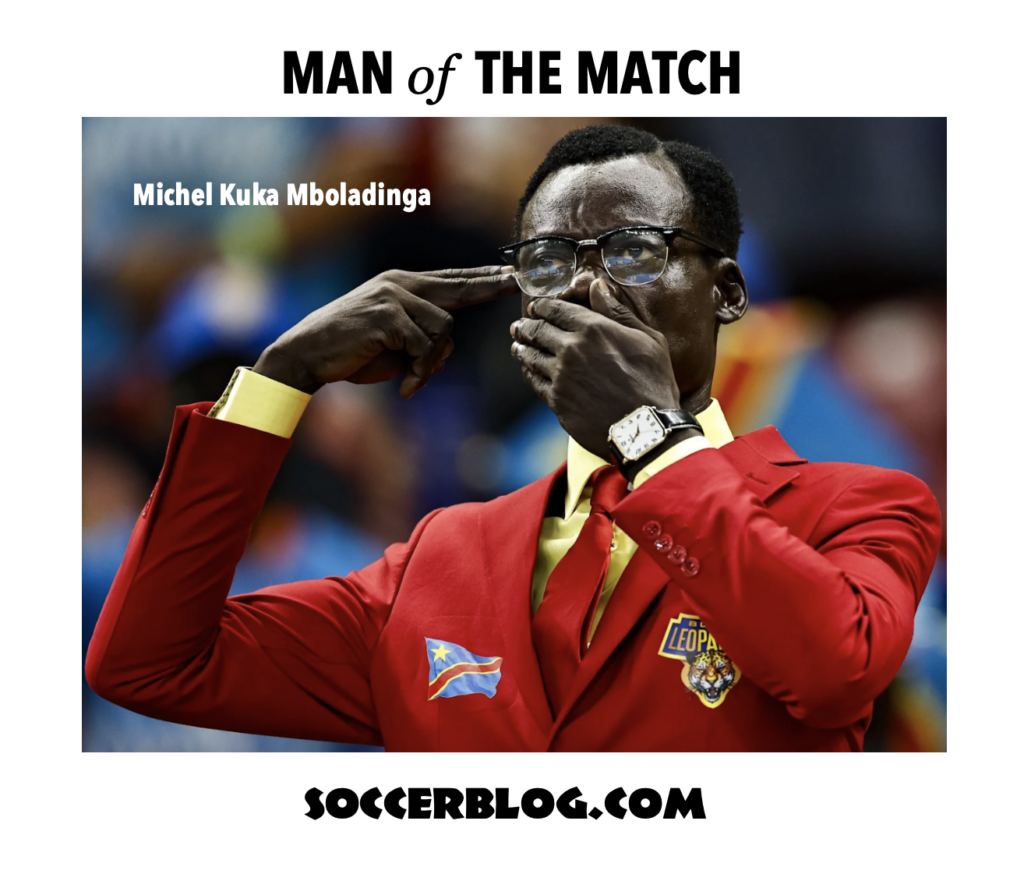
Now his story has collided with something harder than symbolism: borders. According to reports, Mboladinga has been denied a U.S. visa, preventing him from attending DR Congo’s World Cup knockout match in Atlanta. His absence has brought in a stand-in—another “living statue” performing his ritual in his place.
A man who embodies memory has been stopped at the frontier of the present. To understand why that matters, we have to go back to the man he is imitating.
Patrice Lumumba: The Unfinished Independence
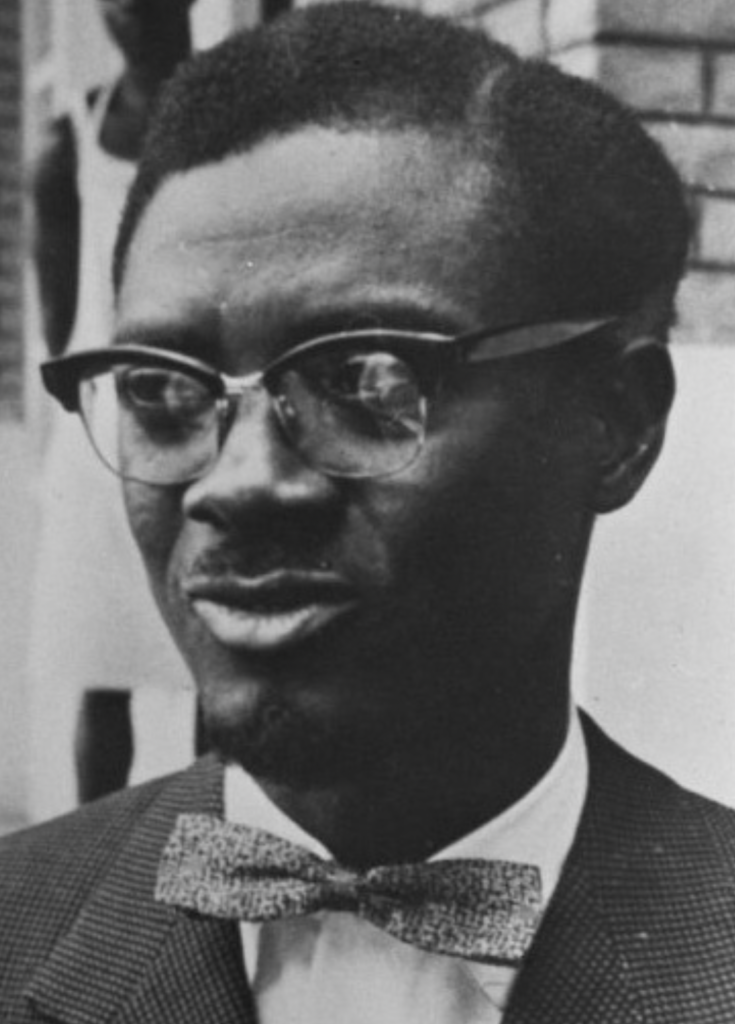
Patrice Lumumba became the first Prime Minister of the Democratic Republic of Congo in 1960, at the moment of independence from Belgium. His time in power was brief, but historically explosive.
Lumumba argued that political independence without economic sovereignty was meaningless. In a Cold War world where Congo’s mineral wealth was strategically vital, that position made him dangerous to powerful interests—both inside and outside the country.
Within months, his government was destabilized. He was removed from office, arrested, and ultimately assassinated in 1961 at the age of 35.
His death did not close a chapter. It opened a wound – the long shadow of colonial brutalism and genocide.
Who Killed Lumumba?
The assassination of Patrice Lumumba is not attributed to a single actor. It is widely understood as a joint operation shaped by Congolese political rivals and foreign intervention during the Cold War.
On the ground, Lumumba was captured and transferred to the breakaway Katanga region, where he was tortured and executed on 17 January 1961. His death was carried out by a firing squad made up of Katangese authorities and Belgian officers operating with colonial ties still deeply embedded in the region.
Historical investigations—including a Belgian parliamentary inquiry in 2001—acknowledged that Belgium bore “moral responsibility” for the events leading to his assassination, including political interference and complicity in his transfer to Katanga.
The United States, through the CIA, has also been implicated in broader destabilization efforts against Lumumba’s government during the Cold War, although the precise extent of involvement in the assassination itself remains debated among historians.
What is not debated is this: Lumumba was eliminated in a convergence of internal power struggles and external geopolitical interests, with colonial structures still actively shaping post-independence Congo.
In other words, his death was not just an event. It was a system. And that system is still alive.
The Superfan as Living Monument
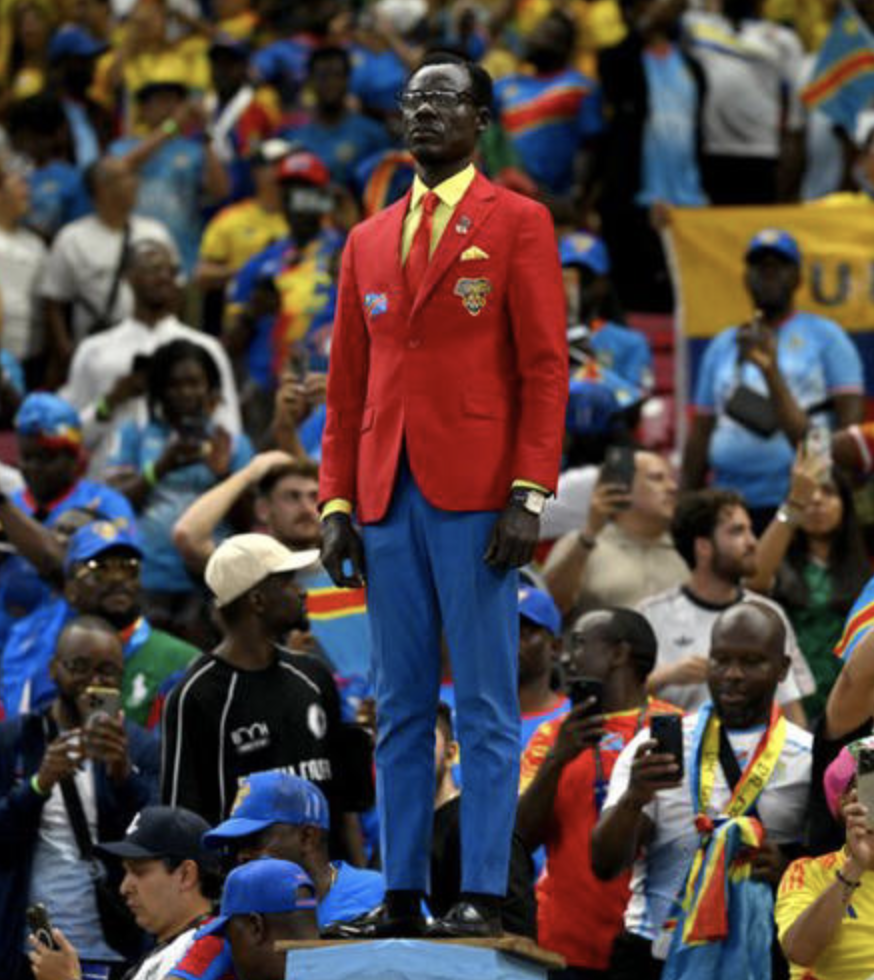
Mboladinga’s performance as “Lumumba Vea” is simple and unsettling. He does nothing.
For 90 minutes, while crowds erupt and players move through exhaustion and triumph, he remains perfectly still. One arm raised. No reaction. No celebration. No collapse into emotion.
His pose mirrors the statue of Patrice Lumumba in Kinshasa.
This is not imitation for spectacle. It is repetition as remembrance.
In stadiums defined by noise, his stillness functions as interruption. A refusal to fully enter the grammar of modern fandom.
He is not merely watching the game. He is holding a memory in place, denying the erasure of a blood-stained history of imperialism.
Visa Denial: When Memory Meets Borders
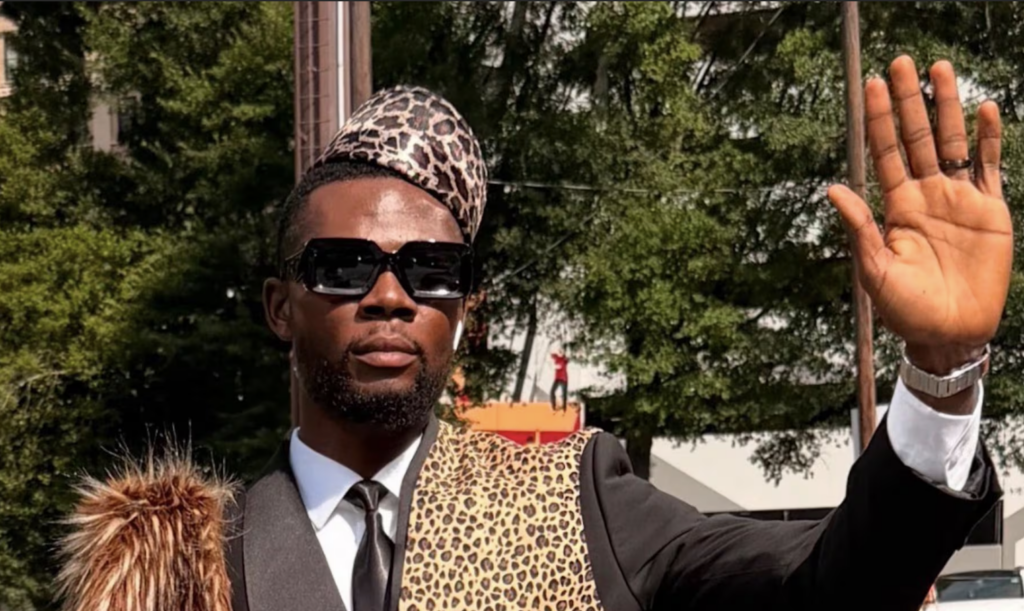
The visa denial changes the meaning of the ritual.
Reports confirm that Mboladinga was unable to obtain a U.S. visa in time for DR Congo’s match in Atlanta, forcing him to remain outside the tournament’s physical space.
No detailed public explanation has been provided, which is typical for visa decisions. But the symbolic effect is immediate: the figure who represents continuity has been excluded from the moment of continuity.
A super-substitute has taken the field.
Why Lumumba Still Haunts the Present
Patrice Lumumba’s assassination did not end his political life. It transformed it.
He has become a condensed symbol of unfinished sovereignty: independence declared but not secured, dignity asserted but violently interrupted.
That is why he continues to appear in unexpected places—from political speeches to protest movements, and now, in the ritualized stillness of a football fan.
Lumumba is not simply a historical figure. He is history – a symbol of the degenerative legacy of colonialism.
Football as a Stage of Political Memory
Football often pretends to be escapism, but in many post-colonial contexts it functions as something closer to a public archive.
It carries identity in emotional form rather than institutional form. It compresses history into gestures, chants, colours, and bodies.
In DR Congo, the national team is not just a team. It is a temporary embodiment of unity across a fractured historical landscape.
That is why “Lumumba Vea” matters. He is not an interruption of football culture. He is an intensification of it.
His stillness turns spectatorship into remembrance.
The Meaning of Being Stopped
Even symbols are not exempt from systems of power. In the case of DR Congo’s “Lumumba Vea,” being denied a visa is not just a bureaucratic inconvenience—it is a moment where global mobility regimes intersect with historical memory. A figure who exists to embody continuity, stillness, and remembrance is physically prevented from entering the space where that memory is meant to be performed. The irony is sharp: a man who turns himself into a living monument to a leader whose life was interrupted is himself interrupted by borders, paperwork, and geopolitical filtering. What looks like administrative procedure becomes, in effect, a quiet assertion of who gets to move freely through the world—and whose presence, even symbolic, is conditional.
Stillness After History
There is a temptation to treat this as a curious sports story: a superfan, a statue pose, a visa issue, a substitute.
But beneath it sits something older and heavier.
A leader was killed in a convergence of colonial power, Cold War politics, and local conflict. His death became unresolved history. That history became symbol. And that symbol now lives inside a football stadium—embodied by a man who refuses to move.
And then, that man was stopped at the border.
So what remains is not just a fan or a game or even a ritual. What remains is a question that keeps repeating itself in different forms: Who is allowed to carry memory across borders—and who is not?
Stephen Miller’s racist clock is still ticking. And the world still cries out against injustice.